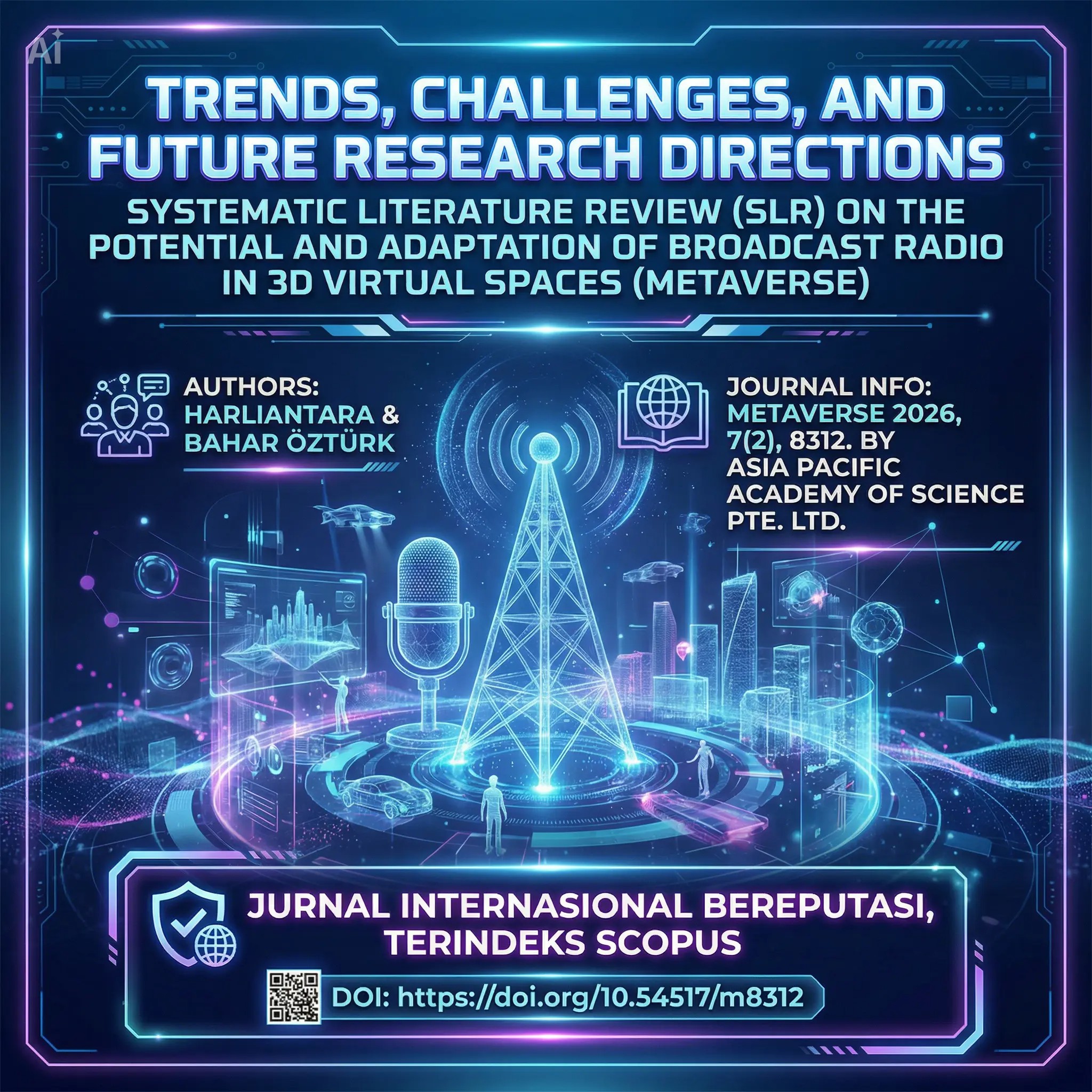
By methodically mapping and synthesizing the existing literature, this study identifies new trends, multidimensional problems, and future research topics related to the adaptation and potential of Broadcast Radio within the metaverse ecosystem. In accordance with the PRISMA 2020 standards, a Systematic Literature Review (SLR) was carried out. Scopus, Web of Science, IEEE Xplore, and ScienceDirect were among the main academic databases searched, with an emphasis on the revolutionary years of 2020–2025. The theme synthesis included 37 peer-reviewed articles, all of which were selected using a rigorous method. In contrast to the old model of passive, linear listening, the results show that people are increasingly engaging with media in an inhabited, multisensory, and dynamic way. There are now three main areas of focus in the field of research: (1) the creation of more lifelike virtual studios and spatial interfaces; (2) the improvement of models for social interaction through the use of avatars; and (3) the new ways to make money on the Web 3.0. Using theories of presence and media richness, the results show how spatial auditory and visual social signals enable telepresence, which reframes audience motives within the U&G framework. Technical lag, expensive infrastructure, and complicated regulatory loopholes concerning copyright in 3D areas are some of the enormous obstacles highlighted by the study. To close the digital gap, this SLR gives a path forward for the media sector based on evidence, stressing the need of hybrid accessible approaches. It finds that radio can only survive if it becomes a community-driven platform where users can interact with one another, and it suggests that researchers should focus on studying the immersive age’s sustainable business models and User Experience (UX) in order to make this shift.
https://aber.apacsci.com/index.php/met/article/view/8312
#riset #penelitian #fikomunitomo #unitomo #harliantara #fikomtv #scopus